Make every experiment inform the next.
AutoRxn helps chemists turn existing reaction data into model-informed experimental suggestions—while keeping the search space, observations, and uncertainty visible.
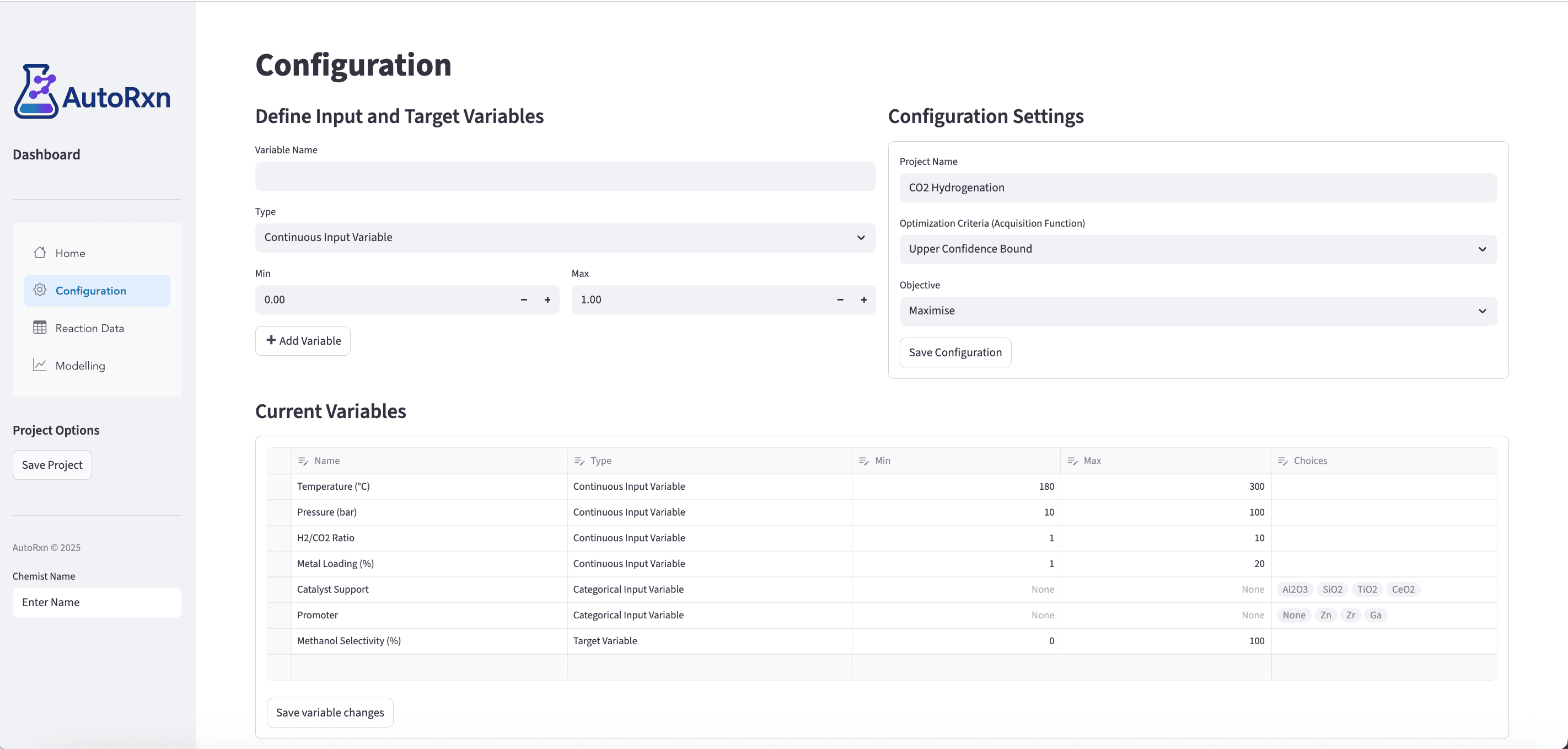
Define the search space
Set continuous and categorical variables, bounds, and the optimisation objective.
Open full-size screenshotBuilt around the experimental loop
A clearer way to plan the next reaction.
AutoRxn brings data preparation, probabilistic modelling, uncertainty, and candidate generation into a workflow designed for experimental chemistry.
Model-informed experiments
Bayesian optimisation ranks candidate conditions using the observations collected so far.
Upper Confidence Bound balances predicted performance with model uncertainty. You define the variable bounds and whether the objective should be maximised or minimised.
Scientifically Grounded
Keep reaction conditions, measured outcomes, and candidate suggestions in one campaign view.
The application keeps the experimental table visible alongside the modelling workflow, so suggestions remain connected to the data used to generate them.
Data-Driven Decisions
Inspect predicted response surfaces and model uncertainty across selected parameters.
Separate response and uncertainty views help distinguish a promising region from one where the model simply has limited evidence.
Iterative by design
Run a suggested batch, return measured results, and use the expanded dataset for the next cycle.
The model is updated from observations—not from its own suggestions. Chemists stay responsible for feasibility, execution, and interpretation.
The optimisation loop
How Bayesian optimisation chooses what to run next
AutoRxn uses measured reactions to model an objective and rank possible conditions. This simplified one-parameter slice shows the same logic used across a larger search space.
01 · Observe
Start with measured reactions
Prior results anchor the optimisation. Each point is a reaction condition paired with a measured outcome—not a synthetic label or a model guess.
Existing data can seed the first cycle.
Applications
One optimisation loop, different chemistry.
Configure the variables and measured objective for the campaign in front of you.
How AutoRxn helps: Catalyst Screening & DOEs
Prioritise catalysts, ligands, and bases with Bayesian optimisation under tight screening budgets.
Campaign outcomes depend on the reaction system, data quality, experimental noise, chosen bounds, and available laboratory budget. AutoRxn does not guarantee a particular yield, saving, or number of experiments.
Start with your data
Plan the next informative reaction campaign.
Define the variables that matter, fit a model to measured outcomes, and review candidate experiments before taking them to the lab.